Choosing a grain dust collection system is a safety decision, not merely an equipment purchase. Fine particles can escape at transfer points, bucket elevators, screeners, and truck-loading areas. A visible dust layer on a beam may indicate deeper leakage. The U.S. Chemical Safety Board’s combustible-dust investigation reports repeatedly connect poor housekeeping, inadequate hazard analysis, and ignition sources with serious industrial incidents. OSHA’s Grain Handling Facilities standard, 29 CFR 1910.272, also emphasizes preventive maintenance, housekeeping, and explosion-control measures.
This guide explains how to choose a dust collection system for grain processing by combining process experience with recognized engineering guidance. NFPA 660, Standard for Combustible Dusts and Particulate Solids, provides a current framework for evaluating combustible-dust hazards, while FM Global Property Loss Prevention Data Sheet 7-76 discusses dust-control and explosion-protection considerations. These sources support a practical approach: measure dust generation, identify emission points, assess material explosibility, and verify airflow at the farthest pickup.
Numbers matter. So does context.
A collector sized from catalog airflow alone may fail when filters load, ducts leak, or moisture changes the grain. A system must balance capture velocity, pressure loss, filter selection, grounding, venting, isolation, and safe discharge. NFPA guidance and a qualified dust-hazard analysis should shape the final design. However, standards cannot replace field observation. Walk the line during peak production. Check the dusty corner behind the elevator. Record what operators actually see. That evidence may challenge an otherwise polished specification.
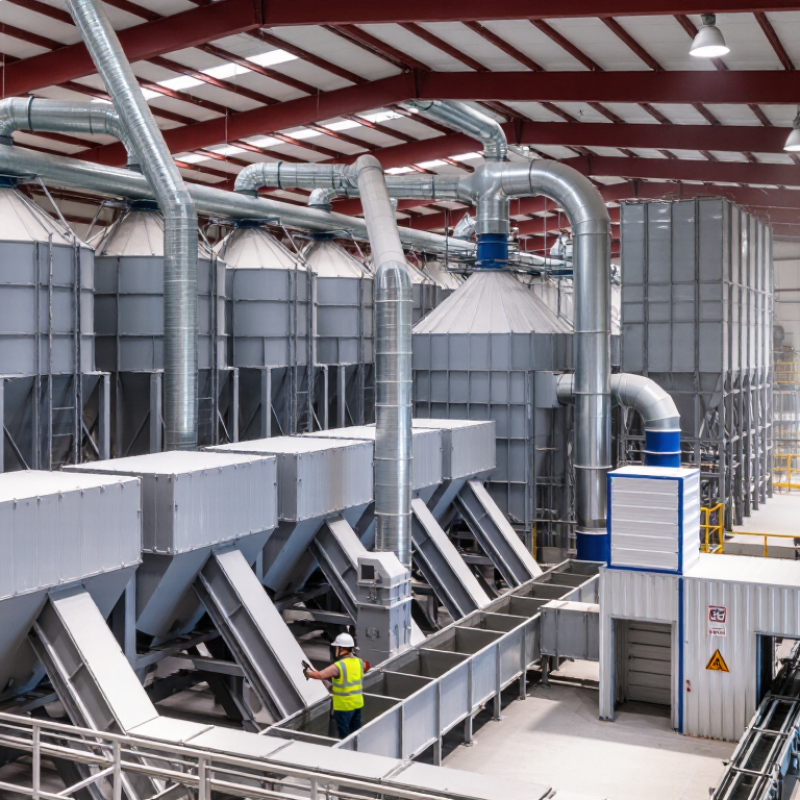
A grain dust collection system removes airborne particles where grain is received, conveyed, screened, or loaded. It uses hoods, ducts, a fan, filters, and a controlled discharge point. At a transfer chute, the hood captures dusty air before it spreads across floors and beams. Filtered air then exits, while collected dust moves into a sealed container or return process. That basic path matters more than appearance.
Fine grain dust can reduce visibility, irritate lungs, foul motors, and settle on warm surfaces. Heavy deposits also create difficult housekeeping conditions and may increase fire or explosion concerns. A reliable system keeps dust near its source, not in workers’ breathing zones. It also supports cleaner equipment, clearer inspections, and more consistent production conditions.
Choosing one requires more than matching a fan to building size. Measure capture points, duct length, elbows, air volume, pressure loss, moisture, and dust loading. Grain type changes the answer. A dry, fine product may need different filtration than damp material. Inspect airflow at each hood, not only at the main outlet. Pressure gauges, alarms, grounding, and accessible cleanout doors support dependable operation. One warning is easy to miss: a powerful fan cannot fix poor hood placement. If the hood sits too far from a falling stream, dust escapes before collection begins. Walk the line during loading. Note vibration, visible dust, and operator feedback during peak flow.
A grain dust collection system captures airborne particles at the source, separates dust from the conveying air, and returns cleaner air to the work area or exhausts it safely. The figures below are representative engineering ranges; actual performance depends on dust properties, airflow, equipment layout, filter loading, and the applicable local safety requirements.
| System Type | Primary Separation Method | Typical Grain-Handling Application | Representative Dust-Removal Performance | Best Suited Particle Fraction | Main Advantages | Important Limitations | Key Selection Check |
|---|---|---|---|---|---|---|---|
| Cyclone Pre-Separator | Uses centrifugal force to move heavier particles to a collection hopper. | Pre-cleaning air from receiving pits, transfer points, grain cleaners, and pneumatic conveying lines. | Approximately 70%–95% for suitable coarse and medium particles; efficiency decreases for very fine dust. | Coarse and medium particles, generally above the fine-dust fraction. | Simple construction, low filter-media consumption, and good protection for a downstream filter. | Usually cannot provide the final level of fine-dust control required by itself. | Confirm the particle-size distribution and maintain adequate inlet velocity without excessive pressure loss. |
| Fabric Filter or Baghouse | Dust is captured on fabric bags or sleeves while air passes through the filter media. | Central dust collection for grain elevators, mills, cleaners, conveyors, and loading systems. | Commonly designed for over 99% collection efficiency when correctly sized and maintained. | Fine, medium, and coarse grain dust. | High fine-particle capture, large capacity range, and suitability for multiple collection points. | Requires filter cleaning, hopper discharge, differential-pressure monitoring, and combustible-dust safeguards. | Check air-to-cloth ratio, filter-media compatibility, pressure drop, hopper capacity, and explosion protection. |
| Cartridge Filter Collector | Fine pleated filter media provides a large filtration area in a compact housing. | Compact systems for smaller grain-processing areas, packaging lines, and localized pickup points. | Often capable of over 99% capture for appropriately sized fine dust. | Fine and medium particles. | Small footprint, high filtration area, and convenient access for filter replacement. | Filter surfaces can load quickly when exposed to heavy coarse dust or high moisture. | Verify dust loading, moisture content, cleaning method, filter area, and the required replacement interval. |
| Wet Scrubber | Water droplets or a liquid film capture dust particles from the air stream. | Special applications where a wet process is acceptable or where hot air and certain contaminants must be treated. | Approximately 95%–99%+, depending on scrubber design, droplet size, and particle characteristics. | Fine particles, provided the scrubber is correctly designed for the dust load. | Can reduce airborne dust and may control some additional soluble or gaseous contaminants. | Creates wastewater or sludge, requires corrosion control, and is not suitable for every grain-processing environment. | Evaluate water use, freezing risk, wastewater handling, corrosion, fan placement, and biological growth control. |
| Local Exhaust Ventilation System | Captures dust at the emission point through hoods, enclosures, ducts, and a fan. | Truck unloading, conveyor transfers, bucket elevators, screens, cleaners, and bag-dumping stations. | Performance is measured by capture effectiveness at the source rather than by filter efficiency alone. | Airborne dust released at transfer and processing points. | Prevents dust from spreading through the building and reduces the amount reaching workers and equipment. | Poor hood placement, damaged ductwork, or insufficient airflow can cause visible leakage and room-wide dust migration. | Use the airflow relationship Q = V × A, where Q is airflow, V is air velocity, and A is hood or duct area. |
| Centralized Multi-Point Collector | A common fan and filter system serves several connected pickup points. | Large facilities with multiple conveyors, elevators, screens, cleaners, and product transfer locations. | Can provide high overall capture efficiency when all branches are balanced and the collector is correctly sized. | Mixed coarse, medium, and fine grain dust. | Consolidates maintenance, supports facility-wide control, and can simplify dust discharge management. | Higher capital cost, more complex duct balancing, and greater impact if the central unit is unavailable. | Calculate simultaneous airflow demand, branch losses, fan capacity, duct transport velocity, and future expansion needs. |
| Portable or Point-of-Use Collector | A compact fan and filter assembly captures dust from one nearby source. | Temporary work areas, maintenance activities, small packaging stations, and low-volume operations. | Suitable for localized control when the hood is close to the dust source and the filter is properly maintained. | Fine and medium dust generated at a single workstation. | Flexible installation, lower initial cost, and quick deployment. | Limited airflow capacity, frequent filter servicing, and less suitable for continuous high-volume grain transfer. | Confirm the collector is rated for combustible dust and that exhaust air does not reintroduce dust into occupied areas. |
Why it matters: Grain dust can accumulate on floors, beams, ledges, equipment, and inside ducts. Fine combustible dust dispersed in air may create a fire or explosion hazard when fuel, oxygen, ignition energy, and dispersion occur together. A suitable system should therefore address source capture, filtration, dust discharge, housekeeping, static control, inspection access, fire prevention, explosion venting or suppression where required, and isolation between connected equipment.
Start with the process, not the equipment catalog. Fine flour dust suits compact dry-media collectors. Larger systems suit continuous milling and conveying. Cyclones remove coarse particles but rarely capture fine flour alone. Wet systems may affect hygiene, corrosion, and waste handling.
It works well for dry, fine dust and limited floor space. Its compact filters provide strong filtration. However, sticky dust can clog them quickly. Short duct runs help reduce pressure loss.
Choose one for larger air volumes and continuous production. It fits mills, sifters, and transfer points. Pulse cleaning keeps filter bags active. Compressed-air demand and service access still need planning.
Usually, no. A cyclone can remove heavier husk particles first. This protects downstream filters from excessive loading. Fine flour dust may pass through it. A second filtration stage is often needed.
List every pickup point, duct, elbow, and machine operating together. Measure airflow while conveyors are running. Include pressure losses, leaks, and future production changes. Empty tests can mislead.
Look around elbows, rotary valves, ledges, and fan inlets. Check for hidden dust buildup. Inspect hood distance from each dust source. A powerful collector cannot fix a poorly positioned hood.
Use conductive, bonded, and grounded components. Provide suitable electrical equipment and verified explosion protection where required. Install pressure gauges before and after filters. Check differential pressure, leakage, vibration, and filter condition weekly.
Reserve space, electrical capacity, and spare filter capacity. A 15–25% allowance may help. It cannot replace recalculated airflow. Recheck assumptions after adding conveyors or changing grain moisture. I would rather reserve too much space than crowd the equipment room.
Choosing the right grain dust collection system is essential for maintaining clean operations, protecting workers, and supporting reliable grain processing. The process begins with understanding how dust is generated, where it accumulates, and how combustible or airborne particles may affect facility safety. A proper assessment should consider equipment layout, production volume, dust characteristics, airflow needs, and applicable safety requirements. These factors help determine whether a central, localized, or multi-stage collection approach is most suitable.
When learning how to choose a dust collection system for grain processing, compare collector types based on filtration efficiency, pressure drop, cleaning method, capacity, and ease of maintenance. The system should provide sufficient airflow without excessive energy use and include appropriate safeguards, monitoring, and access for inspection. Installation planning should account for duct routing, discharge handling, noise, and future production expansion. Regular filter checks, dust removal, and preventive maintenance will help preserve performance and reduce operational risks over time.

 Jiujie Machine